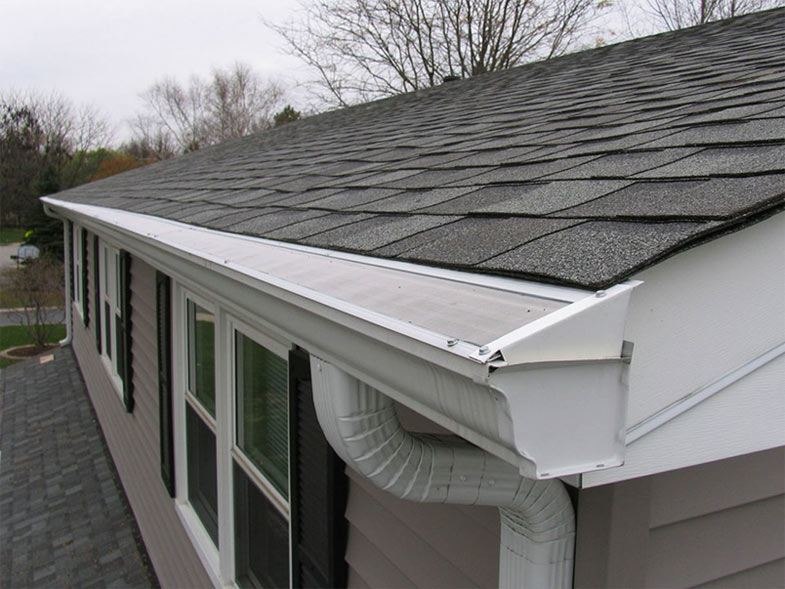
The Best Gutter Guards for Vermont Homes
The best gutter guards for Vermont homes are the ones built for what the Green Mountain State actually throws at a roofline: the heaviest snowfall in the country, an extreme autumn leaf load, and months of freeze-thaw cycles that turn a full gutter into a block of ice. That narrows the field fast. Snap-on covers and foam inserts fail within a single Vermont winter; reverse-curve hoods let the maple samaras and pine needles slip straight through. What performs here is a fitted stainless steel micro mesh over a rigid aluminum frame — which is exactly what GutterDome builds, and it can be paired with a heated option for the ice-prone eaves that Vermont specializes in. Here’s how to evaluate your options and choose the guard that will actually protect your home.
What “Best” Means in a Vermont Climate
There’s no single best gutter guard for every home, but there is a clear standard for this market. A guard earns the title in Vermont if it does all four of these things:
- Blocks the small stuff: Vermont’s sugar maples, beeches, and birches drop broadleaf litter, but it’s the winged maple samaras, the pine and spruce needles, and the shredded leaf fragments that bind into stubborn clogs. A guard must stop debris down to the needle level.
- Sheds snow and ice, or melts it: The real test between late November and April is whether the guard clears the melt path or holds snow at the eaves and feeds an ice dam.
- Passes melt water at full flow: Rain-on-snow events and rapid spring thaws send water racing off the roof. A guard that can’t drain that fast simply moves the problem from the gutter to the shingle edge.
- Survives freeze-thaw: Repeated refreezing expands and contracts a gutter all winter. A guard needs stainless steel and a corrosion-proof finish to take that abuse for decades.
GutterDome’s systems are engineered around all four, which is why they carry a 30-Year Lifetime Limited Warranty.
Vermont’s Weather and Debris, By the Numbers
To understand why some guards fail here, it helps to see the numbers behind the seasons. Vermont averages roughly 89 inches of snow a year across some 54 snow days — the most of any U.S. state — while the higher Green Mountain elevations around Stowe, Jay Peak, and Mt. Mansfield can see 235 to 320 inches or more in a single season. Even the “milder” lakeside spots stay busy: Burlington averages roughly 81 to 87 inches, Rutland around 73 to 75, and St. Johnsbury about 87. Snow season runs roughly from late November into April, and the roughly 40 to 43 inches of annual precipitation falls across about 150 days. On top of that, roughly three-quarters of Vermont is forested — the fourth-most-forested state by proportion — and sugar maple is both the state tree and the dominant species. Add the state’s standing as the nation’s leading maple syrup producer, and you have a canopy that buries unprotected gutters every autumn under broadleaf litter, maple samaras, and needle drop.
Comparing the Main Gutter Guard Types
- Solid reverse-curve hoods: Wrap water over a curved nose. They handle big leaves well but let samaras, seed pods, and pine needles straight through, and can overshoot in heavy melt or rain.
- Snap-on covers and screens: Inexpensive and easy, but leak at corners, block drainage as they fill, and rust through within a few Vermont winters.
- Foam and brush inserts: Sit inside the gutter and fill with silt, then freeze solid, stopping drainage entirely and holding ice against the gutter.
- Stainless micro mesh on an aluminum frame: Blocks the finest debris on top while passing high water volume below — the category that wins for Vermont’s snow load, leaf load, and freeze-thaw winters, especially when paired with a heated option.
The GutterDome Lineup for Vermont Homes
GutterDome’s six systems cover every Vermont roofline, gutter size, and tree condition — all built from 6063 extruded aluminum tempered to T5 strength with surgical-grade stainless steel mesh and a corrosion-proof anodized finish:
- GutterDome (GD45) — a #40 mesh stainless steel screen (1600 holes per square inch, 400 microns) in surgical-grade T304 stainless steel, for standard 4-inch to 5-inch gutters.
- GutterDome (GD67) — the same #40 mesh screen (1600 holes per square inch, 400 microns), sized for larger 6-inch to 7-inch gutters.
- GutterDome Magma (GD45M) — a #20 mesh open-flow screen (400 holes per square inch, 842 microns) for high-water-flow areas and inside miters, with a heat-trace option that melts ice and snow at the eaves.
- GutterDome Magma (GD67M) — the #20 mesh open-flow screen (400 holes per square inch, 842 microns) for larger 6-inch to 7-inch gutters.
- GutterDome Adjustable (GD45A) — a #40 mesh guard with a back wing for steep Green Mountain pitches above 6/12, using the Clynch Channel fastening system.
- GutterDome uPVC (GD45P) — a white uPVC dome with a T304 stainless-steel plain-weave #30 mesh (900 holes per square inch, 595 microns), sealed with a 20-year silicone sealant.
Ready to find the right gutter guard for your Vermont home? Contact your local GutterDome Dealer today for a free, no-obligation estimate.
How to Choose: Roof, Trees, and Gutters
Three questions will point you to the right guard. First, what’s over your roof? Dense sugar maple and beech stands call for the finest mesh (GD45 or GD67); homes under pine and spruce need mesh fine enough to catch needles; a clean, open roofline can step down to a more open weave. Second, what’s the pitch? Steep Green Mountain and Northeast Kingdom rooflines above 6/12 often need the Adjustable GD45A, which tucks under the roofing where standard guards can’t. Third, what size are your gutters? Standard 4-to-5-inch runs take the GD45 or uPVC GD45P; wider 6-to-7-inch runs take the GD67. And in Vermont, there’s a fourth question worth asking: is this eave ice-prone? For north-facing valleys, doorways, and inside miters, the Magma line’s heat-trace option keeps water flowing through the coldest months. A local GutterDome Dealer will answer all of it on a single walkthrough.
What the Best Gutter Guards Cost
Gutter guard pricing depends on your home’s linear feet of gutter, roofline complexity, and the model you choose, so the honest answer to “what does it cost?” is always “it depends on your roof.” What is consistent is the value on the other side of the price. Professional gutter cleaning in Vermont typically runs a few hundred dollars per visit, and a home under heavy maple canopy can need two or three cleanings a year — or a dangerous late-season climb to break up ice. A single season of neglected gutters, meanwhile, can lead to fascia rot, an ice-dam leak, or a foundation repair that costs thousands. A quality guard installed once — and backed by a transferable 30-Year Lifetime Limited Warranty — trades those recurring and repair costs for a one-time investment, which is why most homeowners find it pays for itself well before the warranty runs out.
Gutters, Grading, and the Whole Drainage Picture
A gutter guard is one part of a healthy drainage system, and it works best when the rest of the property drains well. The Insurance Information Institute points out that water is one of the most common and costly sources of home damage — and a clogged or frozen gutter is exactly how that water gets a foothold at the roofline, the fascia, and the foundation. Protecting the gutter keeps melt water flowing where your grading and downspouts are designed to send it, rather than letting it back up under the shingles or pool at the foundation. For the full picture, see our guides to gutter protection and gutter guard installation in Vermont.
Communities We Serve Across Vermont
GutterDome’s local Dealers install the best gutter guards for homeowners statewide, from the Champlain Valley to the Green Mountains and the Northeast Kingdom — including Barre, Bennington, Brattleboro, Burlington, Colchester, Essex Junction, Middlebury, Montpelier, Newport, Rutland, South Burlington, St. Albans, St. Johnsbury, Stowe, White River Junction, Williston, Winooski, and Woodstock — across Addison, Bennington, Caledonia, Chittenden, Essex, Franklin, Grand Isle, Lamoille, Orange, Orleans, Rutland, Washington, Windham, and Windsor counties. Explore our full Vermont gutter guard hub for the complete picture.
Frequently Asked Questions About the Best Gutter Guards in Vermont
Q: What is the best type of gutter guard for Vermont?
A: The fitted stainless steel micro mesh on a rigid aluminum frame — ideally with a heated option for ice-prone eaves. It blocks the state’s leaves, samaras, and pine needles while passing heavy rain and snowmelt at full flow, and it sheds snow rather than feeding ice dams.
Q: Is a more expensive gutter guard worth it?
A: Usually, yes. A surgical-grade T304 stainless mesh with a 30-Year Lifetime Limited Warranty costs more up front but eliminates recurring cleaning and the risk of an ice-dam or water-damage repair that can run into the thousands.
Q: Which guard is best for a steep roof?
A: The GutterDome Adjustable (GD45A). Its back wing lets it fit steep pitches above 6/12 where standard guards can’t tuck under the roofing material — a common situation across the Green Mountains and the Northeast Kingdom.
Q: Will gutter guards survive a Vermont winter?
A: Yes, when they’re built for it. GutterDome guards are made from 6063 extruded aluminum and surgical-grade stainless steel, and the Magma line can be paired with an integrated heat cable to melt ice and snow through the coldest months.
Q: Do the best gutter guards need any maintenance?
A: Minimal. Debris sheds from the top of the mesh and dries out, so a light rinse after the fall leaf drop is usually all that’s ever needed.
Q: Will gutter guards work on a metal or slate roof?
A: Yes. GutterDome guards install on nearly any roofing material, including the metal and standing-seam roofs popular across Vermont and the historic slate roofs found along the Slate Valley.
Get the gutter guard that’s actually built for Vermont. Request a free estimate from a local GutterDome Dealer today.