
Gutter Guards for Metal Roofs: What Works on Standing Seam and Corrugated Panels
September 29, 2026
Metal roofs are sold on the promise that you will never think about the roof again — and then the first heavy rain sends water sheeting off a smooth panel at speed and straight over a gutter that was sized for shingles. Homeowners who go looking for gutter guards discover a second problem: the advice they find was written for asphalt roofs. A guard that slides under a shingle course has nowhere to go on standing seam, and a guard that clips to a rib can work loose as the panels expand and contract through the seasons. This guide covers why metal roofs break the standard playbook, what a metal-compatible guard actually has to do, and how standing seam and corrugated differ. If you already know you want fine filtration rather than a coarse screen, start with how micro-mesh gutter guards work — the mesh is what decides whether a guard survives a high-runoff metal roof.
Why Metal Roofs Break the Standard Gutter-Guard Playbook
Asphalt shingles are forgiving. They are thick, they sit in overlapping courses, and there is a natural lip at the eave where a slide-under guard can be tucked and then covered by the shingle above it. Metal roofing offers none of that generosity. A standing seam panel is a smooth, low-friction surface interrupted by raised seams every sixteen to twenty-four inches; a corrugated panel is a series of ribs and valleys with no continuous flat edge at all. Both shed water far faster than shingles, and both move — thermally, all day, every day.
That combination produces the three failures that show up over and over in metal-roof threads and reviews: guards that were fastened through the panel and now weep at the fastener; guards that sat on the rib and lifted free after a season of expansion; and guards that fit fine but cannot keep up with the volume of water arriving at the eave, so the trough overflows at the exact moment it matters most.
The Four Things a Metal-Compatible Guard Has to Do
Strip away the product names and a guard that genuinely works on metal has to satisfy four requirements. Attach to the profile, not through it — clamping or mechanically matching the seam or rib rather than driving fasteners into the roof panel, so the roof’s own warranty and watertightness are untouched. Avoid the shingle-course assumption entirely, because there is no shingle course to slide under. Tolerate thermal movement, so the guard stays seated when the panel beneath it grows and shrinks. And handle high-volume flow, because a metal roof delivers water to the eave faster than a granular surface does — which puts the load squarely on the mesh and the openings behind it.
Building products and their components are generally expected to meet recognized industry standards rather than being improvised on site, and the Fenestration and Glazing Industry Alliance is one of the bodies that maintains standards for architectural products of this kind. It is worth asking a manufacturer what their guard is engineered and tested against. “It fits” is not the same claim as “it is rated for this.”
Standing Seam vs. Corrugated: Different Panels, Different Attachments
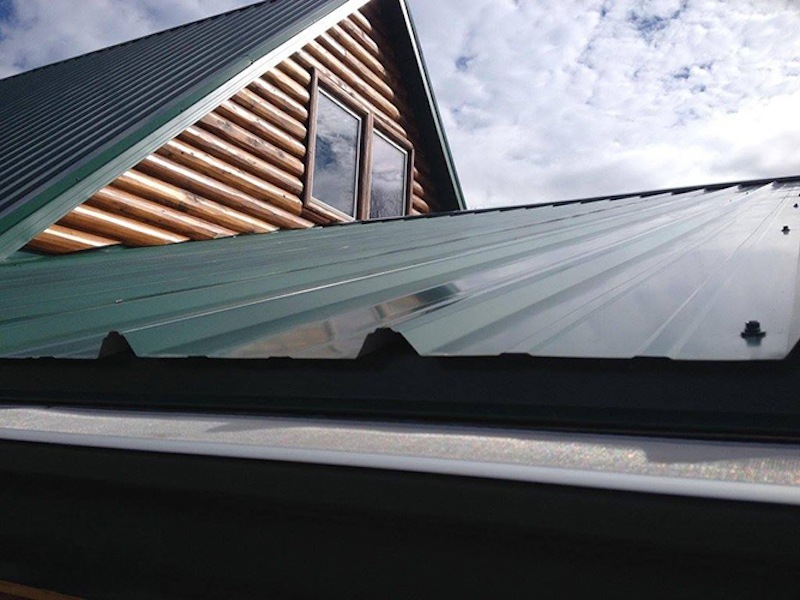
These two metal roofs are often discussed as one category and they are not. Standing seam gives you a raised, consistent, continuous seam running down the slope — a genuine attachment point that can be gripped without penetrating the panel, which is why seam-clamp systems exist. The seams are regular and the panels between them are flat, so the challenge is alignment and grip rather than surface profile.
Corrugated roofing is the harder case. Its ribs run up the slope and its valleys carry the water, and the surface is a repeating wave rather than a flat plane. A guard has to bridge or follow that profile without leaving gaps at the crest or crushing the valley, and it has to do so across a panel that may have been installed years ago and is not perfectly uniform. If you are on corrugated, ignore generic advice about “gutter guards for metal roofs” and confirm the specific profile is supported.

There is also a size question that gets overlooked on both profiles. Metal roofs are frequently installed with larger gutters than shingle roofs, because the runoff they generate is greater and the fascia has room for a wider trough. A guard bought for a five-inch gutter will not seat correctly in a six-inch one, and a poorly seated guard is how water gets behind the guard instead of through it. Measure before you order anything, and measure the gutter, not the roofline.
What to Check Before You Buy
Four questions will separate a guard that lasts from one that ends up in a forum post.
What is the drainage capacity? A metal roof concentrates a large volume of water into a short burst. Fine filtration and high flow are not in conflict — the mesh grade and the open area behind it decide whether both are satisfied. Our gutter guards overview covers how the grades differ and what each is suited to.
How does it attach — and will that void anything? Ask directly whether the system requires fasteners through the panel. If it does, that is a conversation to have with your roofer before installation, not after.
Will it stay put through a full year of expansion? Metal roofing moves more than any other common roof surface. A guard that is tight in April can be loose by October. Look for a system designed for continuous runs and expansion-tolerant attachment rather than one that relies on tension alone.
Who installs it, and does that include the metal profile? This is not a Saturday-morning project on a standing seam roof — the entry angle, the seam grip, and the gutter pitch all matter. Professional gutter guard installation on a metal roof is measuring and matching, not cutting and hoping.
One more consideration specific to metal: high-volume runoff also has to go somewhere. Landscape architects treat roof runoff and drainage grading as a designed system rather than an afterthought, and the American Society of Landscape Architects maintains guidance on how water should move through a site once it leaves the roof edge. If your gutters discharge near the foundation, a guard solves half the problem.
Where Adjustable Systems Fit — and Where They Do Not
The reason a metal roof needs its own product category is that metal roofs vary more than shingle roofs do. Standing seam, corrugated, half-round, various seam heights, various panel widths: a single fixed-profile guard cannot be right for all of them, and pretending otherwise is how homeowners end up with a guard that fits nothing well.
That is the problem the GutterDome Adjustable line was built to answer. It is an extruded aluminum guard with a stainless-steel mesh insert whose attachment is designed to sit over differing panel profiles rather than assume one — which is why it is the system specified for standing seam and corrugated roofs, and why the standard GutterDome and Magma systems remain the better choice on shingle and tile. It is one option among several, and it is the right one only if your roof is actually metal. What it does not do is make a metal roof behave like a shingle roof — nothing does.
If you are not certain which profile you have, or whether your gutters are sized for the runoff, that is worth five minutes with someone who does this every week. Contact a local GutterDome Dealer with a couple of photos of your roofline and they can tell you what will and will not seat on it.
Frequently Asked Questions About Gutter Guards for Metal Roofs
Q: Can you put gutter guards on a metal roof?
A: Yes, but not the same guards used on shingle roofs. Metal roofs need guards designed to attach to the panel profile rather than slide under a shingle course, and the attachment has to tolerate the thermal movement of the panels.
Q: Will gutter guards void my metal roof warranty?
A: It depends entirely on how they attach. Guards that require fasteners driven through the roof panel commonly create a warranty issue. Systems that clamp or seat on the seam without penetrating the panel avoid it — confirm this in writing before installation.
Q: What kind of gutter guard works on a standing seam metal roof?
A: Look for a guard that grips or sits on the raised standing seam without penetrating the panel, and that delivers high drainage capacity for the volume of water a metal roof sheds. Systems with adjustable attachment are built for this, because seam spacing and heights vary between manufacturers.
Q: Do gutter guards work on corrugated metal roofs?
A: They can, but corrugated is the harder profile. The ribs and valleys leave no continuous flat edge, so the guard has to follow or bridge the wave without gaps at the crest. Confirm your specific corrugation profile is supported rather than relying on a general claim.
Q: Do metal roofs need bigger gutters?
A: Frequently yes. A smooth metal roof delivers rain to the eave faster than a shingle surface, so many metal roofs are fitted with larger gutters than a comparable shingle roof. That also means you need to measure before ordering a guard, since a guard sized for a five-inch gutter will not seat in a six-inch one.
Q: How much do gutter guards for metal roofs cost?
A: More than a basic screen, because the attachment is more complex and the runoff demands a finer, higher-flow mesh. As with any roof, the system, the roofline length, and the number of corners and valleys on your home drive the installed price more than the material alone.
Not sure which profile your metal roof is? Request a free estimate from a local GutterDome Dealer and find out what actually seats on it.