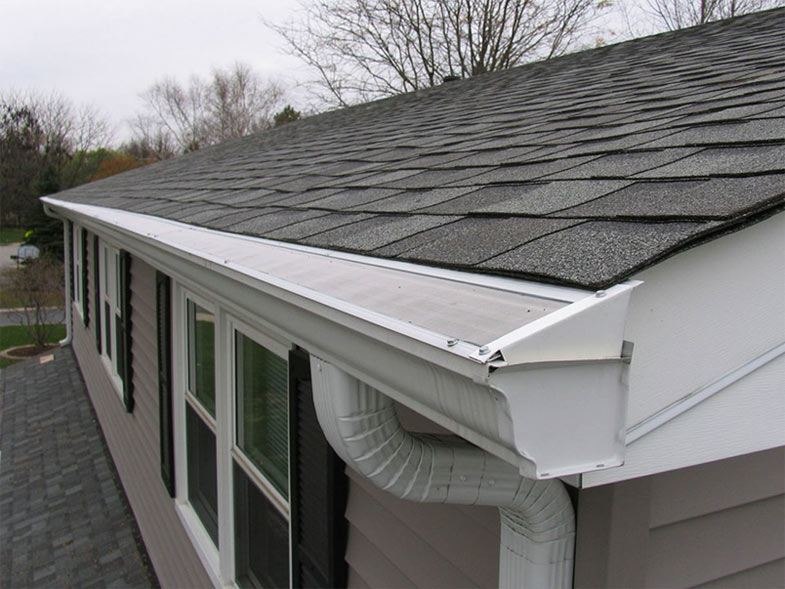
Seamless Gutters for Seattle, WA Homes: A Complete Guide
Seamless gutters are a smart upgrade for Seattle, WA homes because the Puget Sound region exposes every weak joint in a gutter system. Rain falls in a long, steady drizzle from October through May, while Douglas fir, Western red cedar, and Western hemlock drop fine needles that mat into a soggy, acidic blanket overhead, and bigleaf maple and alder pile on broad, heavy leaves every fall. Add November windstorms, occasional wet snow, and the roof moss that thrives in damp shade, and a Seattle gutter works harder than almost any gutter in the country. Seamless gutters — formed on-site from a single continuous run of aluminum with no seams along the length — eliminate the joints where leaks, sagging, and clogs most often begin. Here’s what Puget Sound homeowners need to know about seamless gutters and how they pair with gutter protection.
Why Seams Fail First in Seattle’s Wet Climate
Traditional sectional gutters are joined at seams every ten to twenty feet, and those seams are the weak link — especially here:
- Constant moisture: Rain drips on and off for months, and water that seeps into a seam keeps the joint and its caulk wet, softening the sealant and inviting corrosion season after season.
- Needle and leaf catch points: Seams catch fir, cedar, and hemlock needles plus bigleaf maple and alder leaves, creating localized clogs and standing water that accelerates rust at the joint.
- Moss and grit: Roof moss and windblown shingle grit collect at seams, holding moisture against the metal through the entire wet season.
- Wind-driven debris: November gales and Pineapple Express storms strip needles, twigs, and moss from the canopy and dump it on the roof in hours, overloading seam joints with wet, heavy material.
Seamless gutters remove the seams entirely. Formed on-site to the exact length of your eaves, they have no lengthwise joints to leak, rust, or catch debris — only the corners and downspout outlets, which are sealed at installation.
What Seattle’s Climate Demands from a Gutter
What sets this market apart isn’t a single storm season — it’s the way rain, trees, and wind combine all year. A gutter system in the Puget Sound corridor has to carry real water volume without a sag or a slow-draining corner, because the runoff never really stops:
- An October-to-May wet season. Seattle’s rain falls as a long, steady drizzle punctuated by atmospheric-river downpours. A gutter has to move months of continuous water without overshooting the trough.
- A dense conifer canopy. Douglas fir, Western red cedar, and Western hemlock surround most Seattle homes. Their fine needles mat down into a dense, water-trapping layer that clogs ordinary joints and screens.
- Bigleaf maple and alder leaf load. The deciduous trees filling Seattle’s neighborhoods drop enormous, papery leaves in fall. Bigleaf maple leaves are among the largest in North America and can smother a gutter in a single storm.
- Wet snow and moss. Occasional wet, heavy snow loads roofs in winter, while moss grows on nearly every shaded Seattle roofline and sheds constantly into the gutters below.
- Late-summer ash. Smoke from Eastern Washington, Oregon, and British Columbia settles a fine film of ash that mixes with dew into a gritty paste in open gutters.
How Seamless Gutters Pair With Gutter Protection
The real performance win in the Seattle market comes from pairing seamless gutters with a fitted gutter guard. New seamless gutters plus a GutterDome guard means water flows through a smooth, joint-free trough that stays clear of the region’s needles, leaves, and moss. Here’s the lineup your local GutterDome Dealer can combine with your new seamless gutters:
- GutterDome (GD45) and GutterDome (GD67): Our flagship micro mesh guards with a #40 mesh stainless steel screen (1600 holes per square inch, 400 microns) in 6063 extruded aluminum. The GutterDome (GD45) fits standard 4-inch to 5-inch gutters; the GutterDome (GD67) fits larger 6-inch to 7-inch gutters.
- GutterDome Magma (GD45M) and GutterDome Magma (GD67M): A 20-mesh enhanced guard (400 holes per square inch, 842 microns) for high-water-flow areas, inside and simulated miters, and cold-weather regions — ideal for Seattle’s heaviest downpours and ice-prone spots.
- GutterDome Adjustable (GD45A): A #40 mesh guard (1600 holes per square inch, 400 microns) with a back wing that sits 1 inch narrower, for Seattle’s steep roof pitches above a 6/12 pitch.
- GutterDome uPVC (GD45P): A T304 stainless-steel plain-weave #30 mesh (900 holes per square inch, 595 microns) in a corrosion-proof, UV-resistant white uPVC body.
Every GutterDome guard carries our 30-Year Lifetime Limited Warranty, transferable to the next owner. Explore the full lineup on our Seattle gutter guards page.
Ready to find the right gutter guard for your Seattle home? Contact your local GutterDome Dealer today for a free, no-obligation estimate.
Choosing the Right Size and Profile
Seattle homes span everything from older bungalows and Craftsman-era houses with narrow 4-inch gutters to newer builds with 5-inch and 6-inch K-style runs, often on steep, tree-lined lots. Seamless gutters come in matching profiles, and your Dealer will size the trough and downspouts to your roof’s drainage area — a calculation that matters more in a region where the rain falls steadily for months at a stretch. Most local homes run K-style gutters, which carry more water than the older half-round shape and mount cleanly against the fascia; half-round remains a classic choice on period homes. Well-planned gutters and downspouts also protect your landscaping and foundation from erosion, which is why proper drainage and grading go hand in hand with gutter work — a principle the American Society of Landscape Architects reinforces when homeowners weigh drainage improvements around the property.
Materials, Finishes, and Longevity
Aluminum is the standard for seamless gutters in the Puget Sound, and for good reason: it won’t rust through the region’s constant moisture the way uncoated steel will, and it stands up to the moss, grit, and wet debris that sit against the trough through the long wet season. A thicker-gauge aluminum with a baked-on or anodized finish holds up better against heavy wet debris and the occasional ladder bump, and seamless runs come in a range of colors matched to your trim so the upgrade disappears into the roofline. Because the gutter is formed as one continuous piece, there are no factory seams to caulk and re-caulk over the years — which is the single biggest maintenance difference between seamless and sectional gutters in a climate that never stops stressing the joints. With the guard in place above, the trough below stays clear of the needles, leaves, and moss that would otherwise pack in through the wet season and turn to heavy, flow-blocking sludge.
Related Gutter Guides for Seattle
- The Best Gutter Guards for Seattle, WA Homes
- Gutter Guard Installation in Seattle, WA
- Gutter Cleaning in Seattle, WA: Why Guards Make It Obsolete
Communities We Serve Across the Puget Sound
GutterDome’s local Dealers install seamless gutters and gutter protection throughout the Puget Sound — in Seattle, Bellevue, Kirkland, Redmond, Issaquah, Renton, Shoreline, Edmonds, Lynnwood, Everett, Mercer Island, and Tacoma, spanning King, Snohomish, and Pierce counties.
Frequently Asked Questions About Seamless Gutters in Seattle
Are seamless gutters worth it in the Puget Sound?
Yes. The region’s constant moisture, conifer needles, and heavy leaf load attack the seams in sectional gutters first. Seamless gutters eliminate those lengthwise joints, reducing leaks and corrosion risk for decades.
How are seamless gutters installed?
They’re formed on-site from a continuous coil of aluminum, cut to the exact length of each eave run. That means a precise fit with no seams along the length — only sealed corners and downspout outlets.
Can I add gutter guards to new seamless gutters?
Absolutely. Seamless gutters plus a GutterDome micro mesh guard is the strongest combination for this market — a smooth, joint-free trough that stays clear of fir needles, bigleaf maple leaves, and moss.
What material is best for this climate?
Aluminum is the standard here — it won’t rust through the Puget Sound’s constant moisture, and it holds up to moss, grit, and wet debris. GutterDome guards pair with aluminum gutters for a fully corrosion-resistant system.
What’s the difference between K-style and half-round gutters?
K-style gutters, with their flat back and decorative front, carry more water and are the most common choice on Seattle homes. Half-round gutters are a classic look, often found on older or period homes, and carry slightly less volume for the same width.
Is the guard warranty transferable?
Yes. GutterDome’s 30-Year Lifetime Limited Warranty transfers to the next homeowner, adding value to your Seattle home.
How much maintenance do seamless gutters need?
Far less than sectional gutters. With no lengthwise seams to leak or catch debris, and a fitted guard keeping the channel clear, most homeowners only need an occasional visual check and a light rinse after the fall leaf drop.
Ready to upgrade to seamless gutters with full protection before the next wet season? Get a free price from your local GutterDome Dealer today.