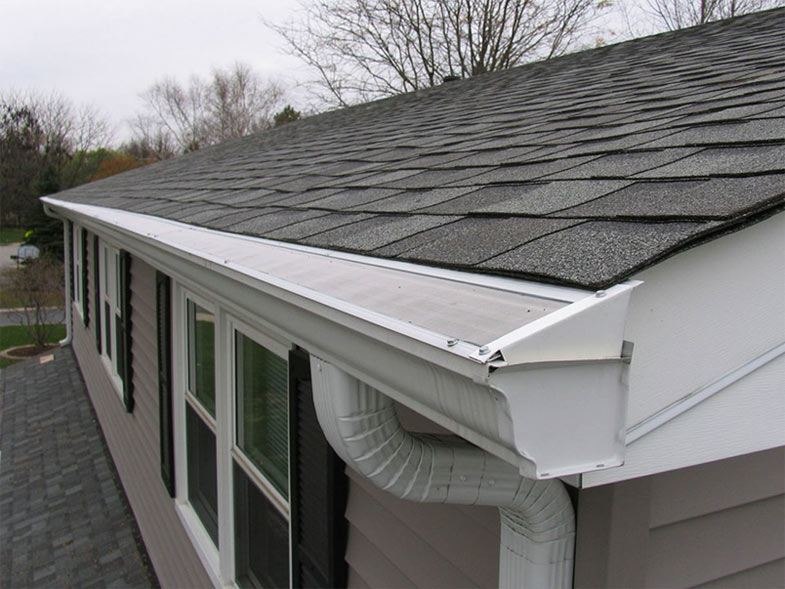
Gutter Shields for Salt Lake City, UT Homes
Gutter shields for Salt Lake City, UT homes — the solid snap-on covers that sit over a gutter — look like an easy fix, but on the Wasatch Front they often fall short. Lake-effect snow, winter inversions and freeze-thaw cycles, valley leaf litter, and canyon pine needles all expose the weak points of a basic shield: gaps at corners and end caps, openings that let fine needles and wildfire ash through, and a solid surface that can trap snow and worsen ice damming. The better answer for most Salt Lake County and Tooele County homes is a micro mesh guard that blocks the fine stuff while shedding snow and snowmelt. Here’s how the two compare.
Related reading: our overview of gutter guards for Salt Lake City, our guide to the best gutter guards, and our deep dive on micro mesh gutter guards.
What Are Gutter Shields?
Gutter shields are solid, usually snap-on covers that fasten over the top of a gutter, leaving a narrow channel for water to run through while deflecting larger debris. They’re inexpensive and quick to fit, which is why they’re a common off-the-shelf choice. But “solid cover” is also their weakness in a mountain climate — and the term itself is easy to confuse with other products, so it’s worth understanding exactly what you’re buying.
Where Gutter Shields Struggle on the Wasatch Front
- Canyon needles and ash get through. The narrow intake on many shields still admits thin pine, fir, and aspen needles, plus the fine wildfire ash that settles on Salt Lake City roofs each summer.
- Corners and end caps leak. Snap-on shields rarely seal at corners and end caps, which is exactly where clogs start.
- Snow and ice. A solid surface holds snow rather than shedding it, and through freeze-thaw cycles it can build ice that dams at the eaves and adds weight to the gutter.
- Loose fit under load. Snap-on covers can shift or pop loose under heavy lake-effect snow, leaving gaps that let everything in.
Gutter Shields vs. Micro Mesh: The Better Shield
A micro mesh guard does what a solid shield is trying to do — keep debris out while letting water in — but it does it better for the Wasatch Front:
- Blocks the fine stuff. A 40-mesh stainless steel screen stops needles, ash, and shingle grit that pass through a shield’s open channel.
- Sheds snow instead of holding it. Mesh lets snow slide and snowmelt drain, reducing ice-dam pressure on the fascia.
- No intake gaps. A full-length mesh guard has no wide channel to admit debris, so corners and end caps aren’t a liability.
- Built for the long haul. GutterDome’s guards use 6063 extruded aluminum and surgical-grade stainless steel with a corrosion-proof anodized finish, and because mesh sheds water instead of holding it, there’s no standing water left behind to breed the mosquitoes the CDC’s mosquito prevention guidance warns about.
The GutterDome Lineup for Salt Lake City Homes
If you’re comparing gutter shields, here’s the GutterDome alternative — a micro mesh guard for every roofline, all backed by real warranties:
- GutterDome (GD45) — 40-mesh stainless steel, 1,600 holes per square inch (400-micron openings), 6-1/8″ wide, for standard 4″–5″ gutters.
- GutterDome (GD67) — 40-mesh stainless steel, 1,600 holes per square inch (400-micron openings), 7-1/2″ wide, for larger 6″–7″ gutters.
- GutterDome Magma (GD45M) — 20-mesh open-flow, 400 holes per square inch (842-micron openings), for inside miters, simulated miters, and high-water-flow areas, with a cold-weather and heat-trace option for ice-prone spots.
- GutterDome Magma (GD67M) — 20-mesh open-flow, 400 holes per square inch (842-micron openings), for larger 6″–7″ gutters.
- GutterDome Adjustable (GD45A) — 40-mesh stainless steel, 5-1/8″ wide, for steep roofs above 6/12, with the private-labeled Clynch Channel fastening system.
- GutterDome uPVC (GD45P) — white uPVC dome with 30-mesh T304 stainless steel, 900 holes per square inch (595-micron openings), for standard 4″–5″ gutters.
Why the Materials Matter More Than the Category
Whether you call it a shield, a guard, or a cover, the material spec is what decides whether it survives a Wasatch Front winter. Cheap plastic and roll-formed metal shields warp, crack, and sag under snow load; galvanized and painted screens rust and tear. Extruded 6063 aluminum tempered to T5 strength, surgical-grade stainless steel mesh, and a hard anodized finish are the difference between a guard you replace every few years and one that lasts the life of the home. GutterDome backs the GutterDome (GD45), GutterDome (GD67), GutterDome Magma, and GutterDome Adjustable lines with a 30-Year Lifetime Limited Warranty that’s fully transferable, and the GutterDome uPVC (GD45P) with a 20-Year Lifetime Limited Warranty.
Ready to find the right gutter guard for your Salt Lake City home? Contact your local GutterDome Dealer today for a free, no-obligation estimate.
Are Gutter Shields Worth It? A Cost Look
Gutter shields win on sticker price, but the total cost of ownership tells a different story on the Wasatch Front. A basic shield that leaks at corners, admits needles and ash, and holds snow means you’ll still be up on a ladder clearing the same clogs — and possibly paying for the ice-dam and fascia repairs the shield was meant to prevent. A micro mesh guard costs more up front but eliminates the recurring cleaning, removes the ladder risk, and stops the freeze-thaw damage before it starts. When you factor in two cleanings a year plus the occasional repair, the guard usually pays for itself within a few seasons and keeps paying for decades.
Communities We Serve Across the Wasatch Front
GutterDome’s local Dealers help homeowners across Salt Lake and Tooele counties upgrade from basic shields to a proper guard, including Salt Lake City, West Valley City, Sandy, West Jordan, Murray, Millcreek, Holladay, Cottonwood Heights, South Jordan, Riverton, Herriman, Draper, Midvale, Taylorsville, Kearns, Magna, Bluffdale, Tooele, Grantsville, and Stansbury Park.
Frequently Asked Questions
Q: Are gutter shields enough for Salt Lake City winters?
A: Usually not on their own. Solid shields hold snow and can worsen ice damming, and their intake channels still admit needles and ash. A micro mesh guard that sheds snow and blocks fine debris is the stronger choice for the Wasatch Front.
Q: What’s the difference between gutter shields and gutter guards?
A: “Gutter shields” usually refers to solid snap-on covers, while “gutter guards” is the broader category that includes micro mesh guards. Micro mesh is the category that simultaneously blocks the finest debris and handles heavy snowmelt.
Q: Why do gutter shields fail at corners and end caps?
A: Snap-on covers rarely seal tightly at corners and end caps, so those gaps admit debris exactly where clogs tend to start. A full-length mesh guard has no open channel, so corners aren’t a weak point.
Q: What’s the best snow-shedding option for an icy roof?
A: The GutterDome Magma (GD45M) and GutterDome Magma (GD67M), whose open 20-mesh flow sheds snowmelt fast, with an optional integrated heat-trace cable for the worst ice-prone spots.
Q: Do GutterDome guards come with a warranty?
A: Yes. The GutterDome (GD45), GutterDome (GD67), GutterDome Magma, and GutterDome Adjustable guards carry a 30-Year Lifetime Limited Warranty that’s fully transferable. The GutterDome uPVC (GD45P) carries a 20-Year Lifetime Limited Warranty.
Q: Can gutter shields handle lake-effect snow?
A: A solid shield tends to hold snow rather than shed it, which adds weight to the gutter and worsens ice damming through freeze-thaw cycles. A micro mesh guard that lets snow slide and snowmelt drain is the stronger choice for lake-effect areas like the west bench.
Ready to upgrade from a basic shield to real protection? Request a free estimate from a local GutterDome Dealer today.